
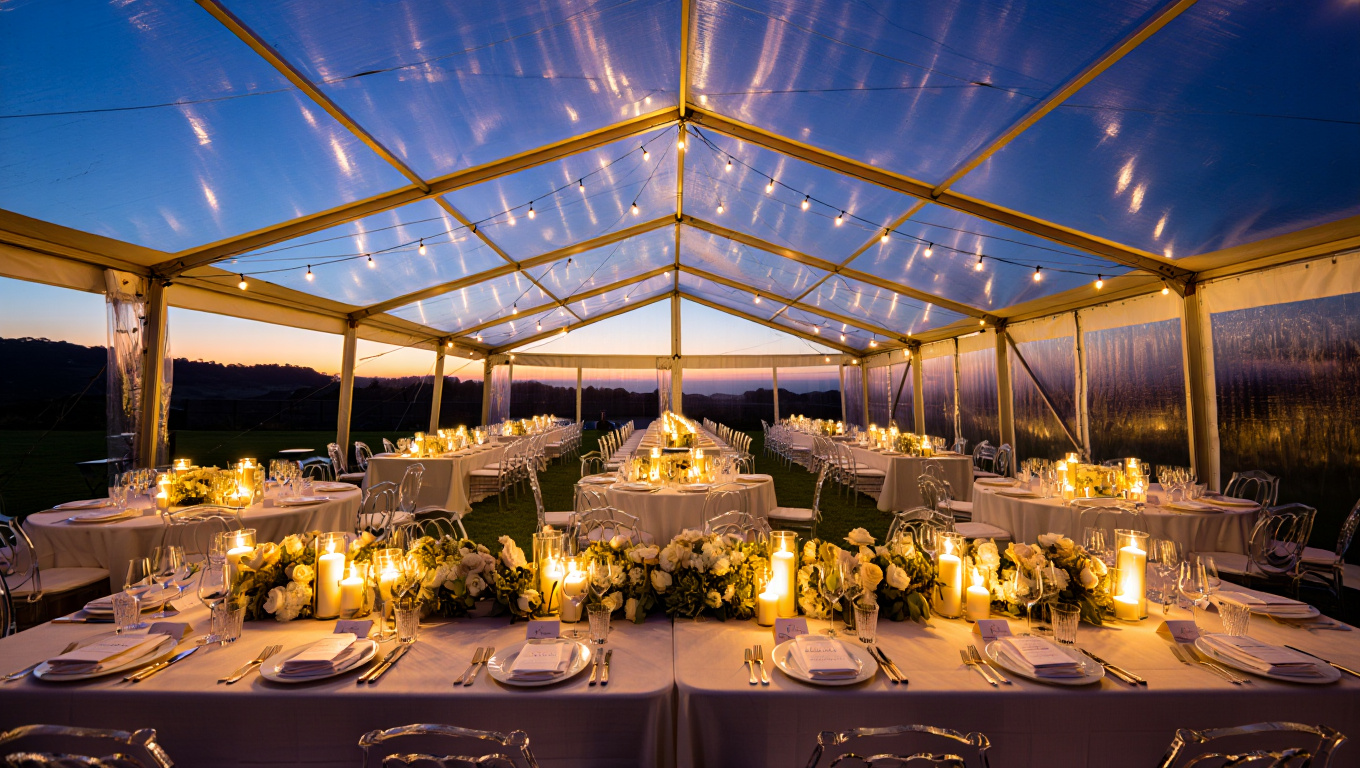
A tent is not always necessary for an outdoor wedding, but a clear weather backup plan is absolutely necessary. If your event keeps guests outside for hours, especially for the reception, a tent quickly shifts from optional to essential. It protects against sun and rain, but it does not make your wedding weather-proof.
Let’s be honest about tents
There’s a romantic idea that a tent is just a design choice. Soft draping, warm lights, maybe a clear top with stars overhead.
In reality, a tent is often a risk decision.
If everything goes perfectly, you might not need one. But weddings rarely operate on perfect conditions. Weather shifts, ground gets muddy, the sun hits harder than expected, or wind picks up right when dinner is served.
That’s where a tent stops being about aesthetics and starts becoming infrastructure, which changes how you choose between frame and popup structures.
And here’s the part people don’t always realize:
- A tent helps with rain and sun
- It does not solve every weather problem
When a tent becomes necessary
You don’t decide on a tent because it looks nice. You decide because the alternative is risky.
Here’s where tents usually move from optional to necessary.
1. Your reception is fully outdoors
Ceremonies are short. Receptions are not.
Once you’re asking guests to stay outside for 4 to 6 hours, everything compounds:
- Sun exposure
- Temperature swings
- Rain delays
- Vendor setup challenges
A small inconvenience turns into a big disruption fast.
This is why most planners treat tents as essential for outdoor receptions, not ceremonies.
2. You don’t have a real indoor backup
This is the biggest decision point.
If your venue doesn’t have a space that can comfortably hold your full guest count, you’re essentially building your own venue outside, so it helps to work out the size that will actually hold everyone.
And once you’re doing that, a tent becomes part of the foundation.
Without it, your only backup plan is hoping the weather cooperates.
3. Heat or sun is a real factor
Heat isn’t just uncomfortable. It can be a health issue. Shade, water, and rest are key to preventing heat-related illness.
A tent gives you shade at scale. Not just for a few guests, but for everyone.
Still, shade alone isn’t always enough. You might need:
- Fans
- Air conditioning
- Hydration stations
Especially with clear-top tents, which can trap heat more than people expect.
4. Your ground isn’t ideal
Grass sounds great in theory. Until it rains.
Then you’re dealing with:
- Mud
- Sinking chairs
- Slippery walkways
- Guests trying to balance in formal shoes
Accessibility matters too. The surfaces should be stable, firm, and slip-resistant.
A tent often comes with flooring or at least pushes you toward it. That alone can change the entire experience, especially once you see what flooring does to a soft or uneven site.
5. Your vendors need protection
It’s easy to think about guests first. But your vendors are the ones making everything happen.
Caterers, DJs, bartenders, and coordinators all rely on:
- Equipment
- Power
- Stable working conditions
If your site is “raw,” you’re not just renting a tent for guests. You’re often renting additional covered areas just so your vendors can operate properly.
When a tent might not be necessary
There are situations where skipping a tent actually makes sense.
Short, ceremony-only weddings
If your event is quick and you have a clear indoor option ready, you can get away with:
- A small canopy
- Umbrellas
- A flexible timeline
You’re exposed to less risk simply because you’re outside for less time.
Venues with built-in coverage
Some venues already solve the problem.
Think:
- Covered patios
- Pavilions
- Indoor-outdoor hybrid spaces
If they can comfortably handle your guest count and weather scenarios, a tent becomes more of a style choice than a necessity, something you can test by laying your setup into the space you already have.
The biggest misconception: tents make you weather-proof
They don’t.
A tent handles some problems well:
- Rain
- Sun
- Light wind
But once conditions get serious, you’ll need more:
- Sidewalls for wind and rain
- Heating for cold
- Cooling for heat
- Covered walkways
- A real indoor shelter for storms
Even though lightning isn’t a common planning concern in Edmonton, if it does happen, the only safe option is a building or vehicle.
So the real plan is not “tent or no tent.”
It’s: “What’s our full weather strategy?”
A simple way to decide
If you’re stuck, run through this quickly:
- Are guests outside for more than an hour?
- Do you lack a full indoor backup?
- Is weather unpredictable for your date?
- Is your ground soft or uneven?
- Do your vendors need coverage?
If you answered yes to most of these, a tent is probably not optional.
If you answered no to most, you might be able to skip it or go with a lighter solution.
Final thought
A tent isn’t required for every outdoor wedding.
But a plan is.
And for many weddings, especially longer outdoor receptions, the tent becomes the simplest way to turn uncertainty into something manageable.
Not glamorous. Not always cheap.
But often the difference between a stressful day and one that actually feels like a celebration.