
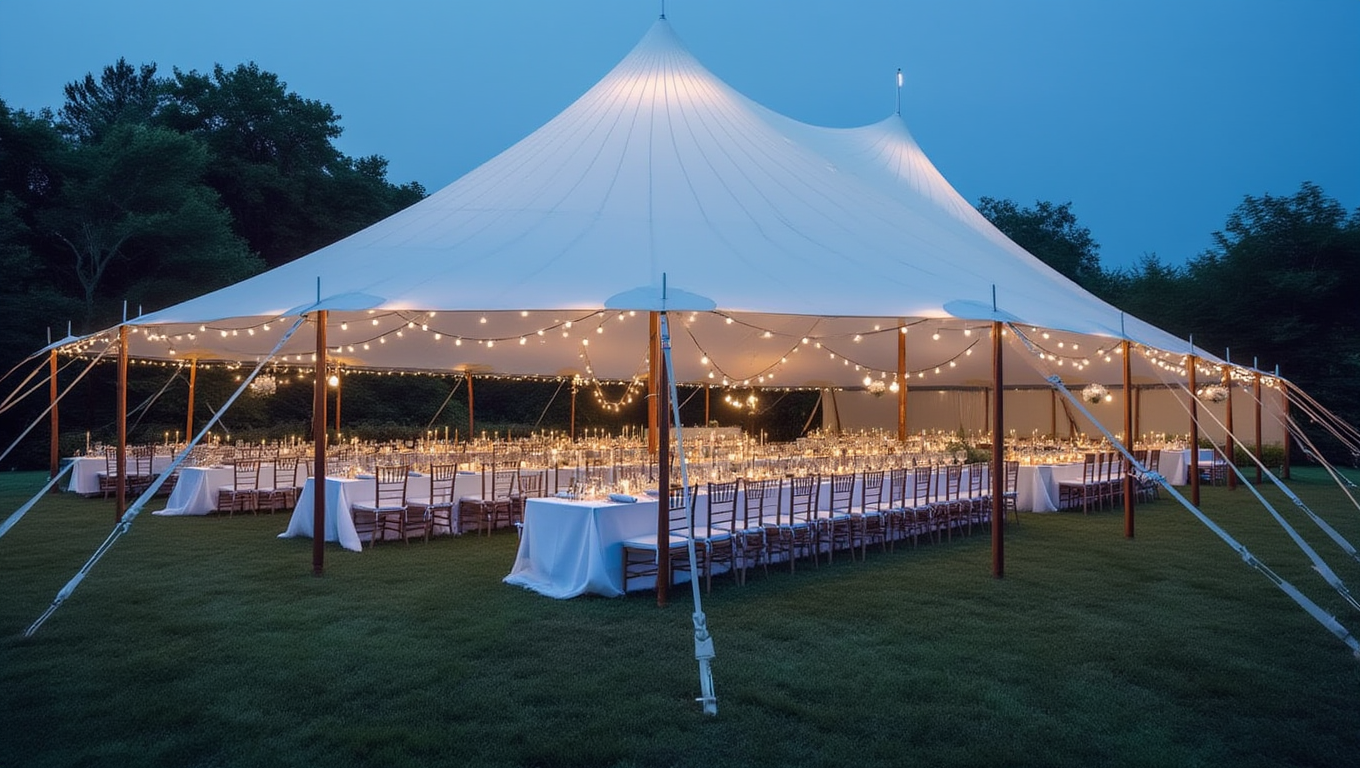
Start with 15–30 square feet per guest, then adjust based on layout. A seated dinner with dancing, bar, and buffet usually lands closer to 20–30 sq ft per person, while a simple ceremony or cocktail setup can sit closer to 10–15 sq ft per person. The real answer depends less on guest count and more on what you’re putting inside the tent.
Why most people get tent size wrong
Here’s the trap: people think “100 guests = X size tent.”
That’s only half the story.
A tent is not just a cover. It’s your venue. Which means it needs to hold:
- tables and chairs
- a dance floor
- bar and lineup space
- buffet or catering stations
- DJ or band setup
- walkways, exits, and breathing room
When you stack all of that together, space disappears quickly. That’s why two weddings with the same guest count can need completely different tent sizes, and why it helps to size the tent around what’s going inside it.
A 100-person ceremony might fit comfortably in a smaller footprint. A 100-person dinner with dancing can easily require double the space.
The only sizing formula that actually works
Instead of guessing, use this simple framework:
Step 1: Start with guest count
This gives you your base.
Step 2: Choose your layout style
Different setups use space differently:
- Round tables take more space
- Long banquet tables are tighter
- Cocktail style is the most space-efficient
Typical planning ranges:
- Seated dinner (round tables): ~15–30 sq ft per person
- Banquet tables: ~13–20 sq ft per person
- Cocktail (standing): ~5–8 sq ft per person
- Ceremony seating: ~6–8 sq ft per person
Step 3: Add the “invisible space”
This is where most people underestimate.
You need extra room for:
- dance floor (often 2–4 sq ft per guest)
- DJ or band (10’×10’ to 12’×20’)
- buffet lines and queuing
- bar traffic
- aisles and exits
Step 4: Add a buffer
Even if everything fits on paper, it won’t feel good without space to move, which is easier to judge when you place the tables and see what’s left over.
A good rule: add 10–20% extra for comfort and flow.
Real tent size examples (what it actually looks like)
Let’s make this practical.
50 guests
- Ceremony only: ~400–600 sq ft
- Dinner + dancing: ~1,200–1,600 sq ft
Typical tents:
- 20’×30’ (simple setup)
- 30’×50’ (full reception)
100 guests
- Ceremony: ~800 sq ft
- Dinner + dance + bar + buffet: ~2,300–2,700 sq ft
Typical tents:
- 40’×60’ (very common)
- 30’×80’
This is where people start to feel cramped if they undersize.
150 guests
- Reception with everything: ~3,200–3,700 sq ft
Typical tents:
- 40’×80’
- 50’×70’
At this size, layout becomes critical. One poor decision can bottleneck the whole event.
200+ guests
- Full wedding build: ~4,000–5,000+ sq ft
Typical tents:
- 40’×100’
- 50’×100’
At this level, you’re essentially building a temporary venue.
The biggest factors that change your tent size
1. Round tables vs long tables
Round tables look great, but they take up more room.
If you want that classic wedding feel, plan for a larger tent.
If you’re tight on space, long banquet tables can save you hundreds of square feet, which is worth checking against the rectangular table sizes on offer.
2. Dance floor expectations
Be honest about your crowd.
- Light dancing → smaller floor
- Party crowd → larger floor
A packed dance floor feels electric. An oversized empty one feels awkward.
3. Buffet vs plated dinner
Buffets need:
- table space
- walking space
- line space
That’s a lot of square footage.
Plated dinners shift that space to tables instead.
4. Bar placement
Bars create traffic.
If you don’t plan space for people to gather, you’ll end up with blocked walkways and crowded exits.
5. Weather add-ons (this is huge in Canada)
In places like Alberta or across Canada, weather changes everything.
A tent might need:
- sidewalls
- heaters or fans
- flooring for mud or uneven ground
Each one adds space requirements and layout constraints.
And here’s the key point most people miss:
A tent helps with comfort, but it doesn’t make you weather-proof.
Don’t forget safety and real-world constraints
This part isn’t exciting, but it matters.
Ground conditions matter more than you think
Grass, dirt, or uneven terrain affects:
- table stability
- guest comfort
- accessibility
Guidelines emphasize surfaces should be stable, firm, and slip-resistant.
That’s why flooring often becomes part of the decision, not an upgrade, and worth pricing alongside the dance floor and event flooring options.
Permits and size thresholds
Once tents get large, they’re treated like structures.
You may need:
- permits
- site plans
- fire safety compliance
- exit planning
In many jurisdictions, larger tents trigger additional requirements around layout and safety.
A smarter way to think about tent size
Instead of asking:
“How big of a tent do you need for your wedding?”
Ask:
“What needs to happen inside this space?”
Because once you map that out, the size becomes obvious.
A simple decision checklist
You’ll likely need a larger tent if:
- your reception is fully outdoors
- you have no indoor backup
- you’re serving dinner under the tent
- you want a dance floor and entertainment
- your site is raw (no built infrastructure)
You can often go smaller or skip a tent if:
- it’s ceremony-only
- you have a nearby indoor option
- your event is short
- your venue already has coverage
Final thought
A tent isn’t just a rental item. It’s the space where everything happens.
When it’s sized right, no one notices. The event just flows.
When it’s too small, everyone feels it.
If you take one thing from this, make it this:
Size for the experience, not just the headcount.