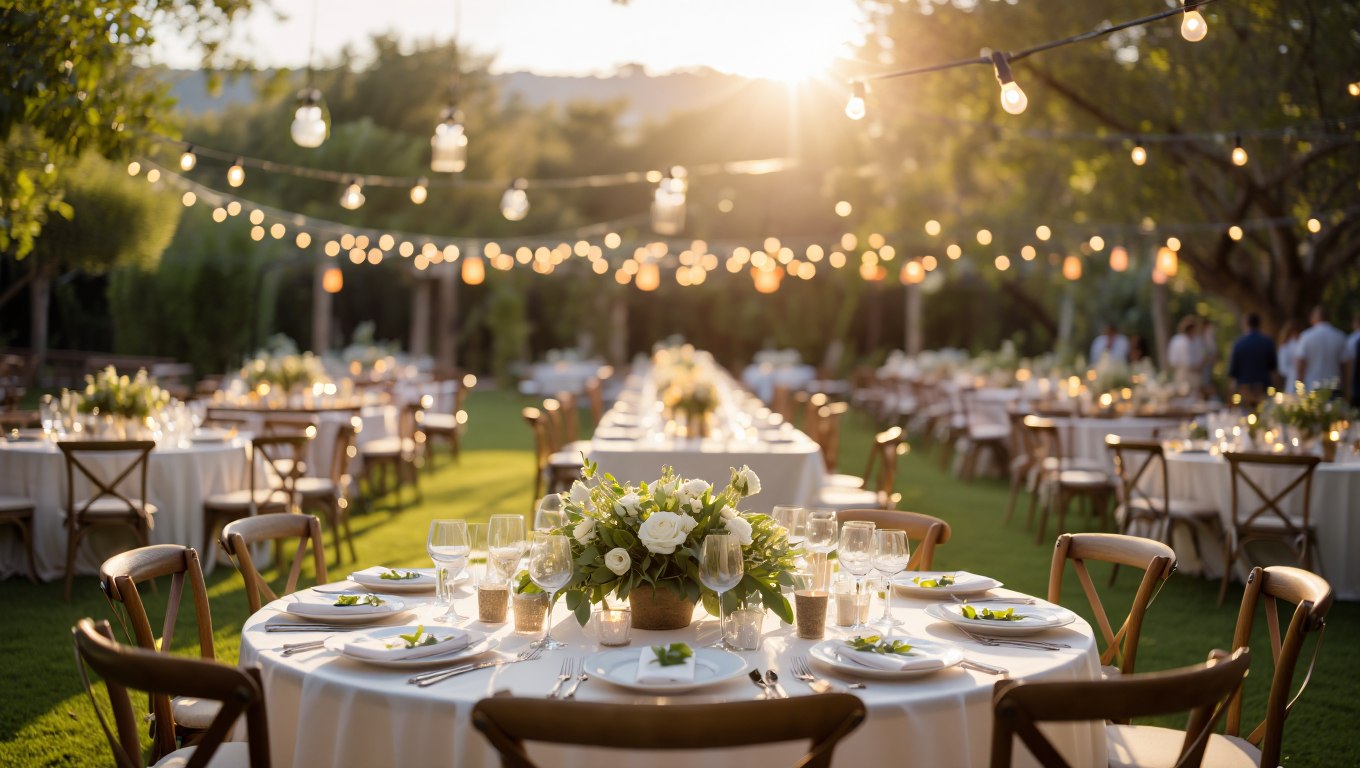
For most weddings, tables should be spaced about 5 to 6 feet apart (edge to edge) for a comfortable guest experience.
This range gives enough room for:
If your layout feels tight on paper, it will feel even tighter in real life once chairs are pulled out and people start moving, which is why it helps to test your spacing at real scale before the day.
There’s a moment during planning where everything looks perfect on paper. You’ve got the guest count, the tables, the layout. Then you picture it in real life. Chairs pulled out. Servers weaving through. Someone’s aunt with a walker trying to get to the washroom.
That’s when table spacing stops being a layout decision and starts becoming a guest experience decision, and why it helps to know how much usable floor a seated reception really needs.
The biggest mistake couples make is thinking table spacing is about fitting more tables.
It’s not.
It’s about what happens between the tables.
The research makes this clear in a different context. When planning outdoor events, spacing and layout are treated as operational infrastructure, not decoration. Once people are seated for hours, moving around, or being served, small spacing issues turn into big problems.
Same idea applies indoors.
A ceremony can get away with tighter spacing.
A 5-hour reception cannot.
When people ask this question, they usually mean one of three things:
You need all three working together.
If one fails, the whole layout feels cramped.
Here’s what consistently works across weddings:
But it will feel tight once chairs slide out.
If this is too small, the whole room feels chaotic.
Tables don’t move. Chairs do.
And they move a lot.
When someone sits:
This is why layouts that “fit perfectly” on paper feel tight in real life.
A good test:
If two people can’t pass behind a seated guest without turning sideways, it’s too tight.
Not all weddings need the same spacing. It depends on how your event actually works.
Even if your tables are spaced well, one bad area can ruin everything.
Common trouble spots:
These areas need extra breathing room, not just standard spacing.
Think of your layout like traffic.
Most of the room flows fine.
But one bottleneck causes everything to back up.
This part gets overlooked way too often.
Good spacing isn’t just comfort. It’s accessibility.
From a practical standpoint:
Guidelines emphasize surfaces and paths that are stable, clear, and easy to navigate , especially in event environments, which is where flooring and carpet runs earn their place.
What this means for your layout:
A layout can look great but still fail someone who needs space.
Spacing isn’t just distance between tables. It’s also what size tables you’re using.
Key insight:
Bigger tables don’t just take more space. They amplify spacing problems.
Here’s a quick way to think about spacing without overcomplicating it:
Example:
That’s your working grid.
Once you map a few tables this way, room size becomes much easier to understand.
You’ll feel it immediately.
Not visually. Physically.
And the biggest one:
The room feels smaller than it actually is.
Everything just works.
Good spacing is invisible. But you feel it all night.
If you’re trying to get this right without overthinking it, use this:
If any moment feels cramped, it probably is.
So, how far apart should tables be at a wedding?
But the real answer is this:
It’s not about distance.
It’s about flow.
If people can move easily, sit comfortably, and not think about the space at all, you got it right.
Walk through our full inventory of tents, tables, linens and decor before you book. Our Edmonton team is on hand to help you plan the details.
Checking who's in...