
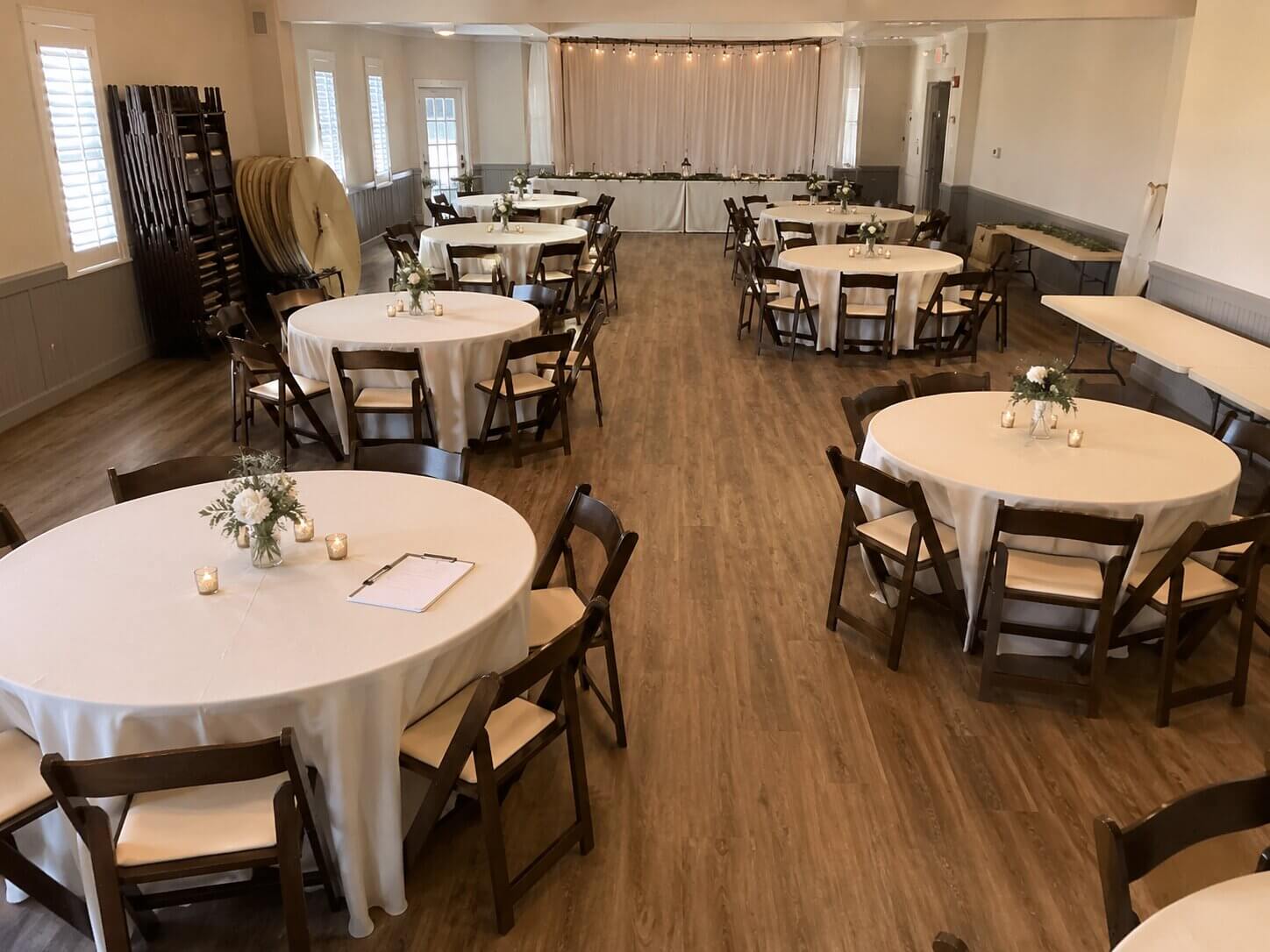
Quick Summary
For a 50-guest wedding, plan for about 1,000 to 1,200 sq. ft. of usable event space for a comfortable seated reception. Cocktail-style setups may need less, while same-room ceremony and reception layouts usually need more. The biggest factors are table style, food service, guest flow, and usable space, not just the venue’s listed capacity.
A 50-person wedding can feel intimate, comfortable, and surprisingly spacious. It can also feel crowded if the space isn’t planned properly.
The challenge isn’t fitting 50 guests into a room. It’s fitting everything else that comes with a wedding.
Dinner tables, food service, décor, and guest circulation all compete for space. That’s why two venues with the same capacity can feel completely different on the wedding day.
Before choosing a venue or tent size, it’s worth understanding how much space a 50-guest wedding actually needs and what factors have the biggest impact on your layout.
Think in Usable Space, Not Venue Capacity
One of the most common mistakes couples make is focusing on venue capacity instead of usable event space.
A venue may advertise that it can accommodate 50 guests, but that doesn’t always mean it can comfortably host a 50-person wedding. Capacity numbers often assume basic seating. Weddings require much more than chairs.
Once you add dining tables, food service areas, décor, gift tables, and room for guests to move around naturally, the available space shrinks quickly.
We’ve seen venues that technically fit 50 people but felt crowded the moment guests arrived. Chairs were pushed close together, walkways disappeared, and every trip across the room meant asking someone to move.
For most weddings, comfort matters more than maximum capacity.
How Much Space Does a 50-Guest Wedding Usually Need?
The amount of space you’ll need depends largely on the type of wedding you’re planning.
A cocktail-style reception requires far less room than a traditional seated dinner. A ceremony-only setup has very different needs than a wedding where guests stay for dinner and an evening celebration.
As a general planning guide:
| Wedding Setup | Recommended Space |
|---|---|
| Cocktail-style reception with light seating | 650 to 900 sq. ft. |
| Seated dinner with banquet tables | 800 to 1,100 sq. ft. |
| Seated dinner with round tables | 900 to 1,250 sq. ft. |
| Ceremony only | 380 to 520 sq. ft. |
| Ceremony and reception in the same space | 1,050 to 1,450 sq. ft. |
For a typical wedding reception, somewhere around 1,000 to 1,200 square feet of usable event space is usually a comfortable target.
The exact number depends on the layout you choose. Round tables generally require more room than banquet tables. A buffet takes up more space than plated service. A ceremony and reception in the same room will need additional flexibility compared to a reception-only setup.
Round Tables or Banquet Tables?
The type of tables you choose can significantly affect how much space your wedding needs.
Round tables create the traditional wedding look and are often the first choice couples picture when planning their reception. Banquet tables, on the other hand, are usually more space-efficient and can help create wider walkways or additional room for décor and food service, so it’s worth comparing what each shape costs you in floor space.
For a 50-guest wedding, the best option depends on your venue, tent size, seating arrangement, and overall vision for the day. We’ve seen situations where simply changing the table layout completely transformed how a space felt without increasing the footprint.
If you’re still deciding between round and rectangular tables, it’s worth spending a few minutes understanding the pros and cons of each setup. Our guide on How Many Tables for a 50-Guest Wedding breaks down seating capacities, common layouts, and which table styles work best for different wedding spaces.
Consider How Guests Will Move Through the Space
When couples picture their wedding layout, they often focus on where everyone will sit.
Just as important is how guests will move throughout the event.
Food service areas, entrances, guestbook tables, gift tables, and walkways all need room to function comfortably. A layout that looks perfect on paper can feel crowded once guests begin standing, mingling, and moving around, which is why it helps to put every zone on the plan, not just the seating.
This becomes especially important in smaller venues and tents where every square foot matters. Leaving adequate space between tables and maintaining clear pathways can make a room feel noticeably larger without increasing the footprint.
It’s one of the biggest differences between a room that technically fits 50 guests and one that comfortably hosts 50 guests.
Planning a Ceremony and Reception in the Same Space
Many couples choose to hold both their ceremony and reception in the same venue space.
It can be a great way to simplify logistics and reduce costs, but it often requires more room than people expect.
The ceremony itself may only need a few hundred square feet. The challenge comes later when the room needs to transition into a reception setup.
Tables, chairs, décor, and vendor equipment all need to be moved while guests enjoy cocktail hour or gather elsewhere.
The goal isn’t simply fitting both layouts.
It’s creating enough flexibility for the transition to happen smoothly.
For most weddings, a combined ceremony and reception space works best when you have at least 1,200 square feet available.
Outdoor Weddings Require More Than Just Tent Space
Outdoor weddings often feel open and spacious, but they usually require more planning than an indoor venue.
Many couples focus on the tent size without considering everything happening around it, which is why it helps to size the tent against the whole site, not just the seating.
You’ll also need room for:
- Tent staking or ballast systems
- Catering operations
- Walkways
- Guest access routes
- Parking
- Washrooms
- Vendor staging areas
- A weather backup plan
We’ve had customers carefully measure the tent footprint only to discover later that they hadn’t accounted for the space needed around the tent for installation and access.
The event space extends beyond the tent walls.
When planning an outdoor wedding, it’s important to think about the entire site, not just the area where guests will sit.
Small Layout Decisions Can Make a Wedding Feel Larger
A well-planned 50-person wedding often feels more spacious than a poorly planned 100-person wedding.
The difference usually comes down to layout.
A few simple decisions can have a surprisingly large impact:
- Use a sweetheart table instead of a large head table.
- Choose table layouts that suit the shape of the room.
- Keep guestbook and gift tables away from major walkways.
- Avoid oversized lounge furniture in smaller spaces.
- Leave comfortable pathways between seating areas.
- Reserve enough room for food service and guest circulation.
None of these changes require additional square footage.
They simply help the space work better.
Questions to Ask Before Booking a Venue
Before signing a venue contract, ask about the actual usable dimensions of the space.
Not just the guest capacity.
It’s also worth confirming:
- Are there columns, fireplaces, permanent bars, or stages that reduce usable space?
- Where will food service take place?
- How much room is available once tables and chairs are set up?
- Is there enough parking for guests and vendors?
- Are accessible routes maintained throughout the event?
- What is the rain plan for outdoor weddings?
- Where can vendors store equipment during the event?
These details often determine whether a wedding feels comfortable or crowded.
Final Thoughts
For most 50-guest weddings, planning for approximately 1,000 to 1,200 square feet of usable event space is a strong starting point.
You may need less for a cocktail-style reception. You may need more if you’re combining the ceremony and reception, planning an outdoor wedding, or working with a venue that has fixed obstacles and limited flexibility.
The goal isn’t simply fitting everyone into the room.
It’s creating a space where guests can move comfortably, conversations flow naturally, and the celebration feels effortless from start to finish.
When the layout is planned properly, 50 guests can be the perfect wedding size.