
Quick Summary:
Party tents can be set up on concrete using heavy weights instead of stakes. For frame tents, GPLANN uses two 350 lb concrete weights per leg, while pop-up tents use one 15 kg cast-steel weight per leg and must be taken down before strong winds or storms.
If you want to put a party tent on concrete, the first question is how it will be secured. Tent stakes cannot be driven into a patio or driveway the way they can be driven into grass.
That does not automatically rule out the location. It simply changes how we hold the tent down. Instead of stakes, we use heavy, purpose-made weights to keep the tent securely in place, and it’s worth mapping the tent onto the actual patio dimensions first.
Can a tent be set up on concrete?
Yes, a party tent can be set up on concrete when the correct weights are used, which is worth confirming when you choose between a frame and a popup structure.
In the tent industry, these heavy weights are often called ballast. Ballast simply means weight used to hold a tent down when stakes cannot be driven into the ground.
The type and amount of weight depend on the tent:
- Commercial frame tents require very heavy weights securely connected to the tent.
- Smaller pop-up tents use purpose-made weights attached at every leg.
A frame tent may look sturdy when it is standing, but the frame alone does not secure it. Wind can catch underneath the roof and cause an unweighted tent to lift, slide or shift. A pop-up tent has the same concern, even though it is smaller.
There is no single amount of weight that works for every tent. A weight made for a small pop-up cannot replace the much heavier concrete blocks needed for a commercial frame tent.
How do you secure a party tent on concrete?
For a frame tent, heavy blocks take the place of the stakes that would normally go into grass. The blocks are placed at the tent legs and firmly attached to the tent with strong straps.
For a pop-up tent, weight must be placed at every leg. Securing only one or two sides can still allow the unweighted part of the tent to lift or move.
For frame tents, we strongly discourage using improvised weights such as water barrels, loose sandbags, patio stones or other heavy objects found around the property. An object may feel heavy without being suitable for securing a large frame tent. The weight also needs to sit firmly on the surface and connect properly to the tent.
Pop-up tents are different. Water barrels, sandbags, patio stones or other heavy weights can be used, provided every leg is weighted and the weights are secured so they cannot slide away or become detached. GPLANN offers purpose-made 15 kg cast-steel weights for this job.
Even when properly weighted, a pop-up tent is not recommended for storms or strong winds. If bad weather is in the forecast, the tent must be taken down before it arrives. If the weather begins to deteriorate during the event, stop using the tent and take it down before conditions become unsafe.
How GPLANN installs a frame tent on concrete
GPLANN uses concrete blocks to hold down frame tents installed on concrete. We do not drive stakes through or drill into the customer’s patio or driveway.
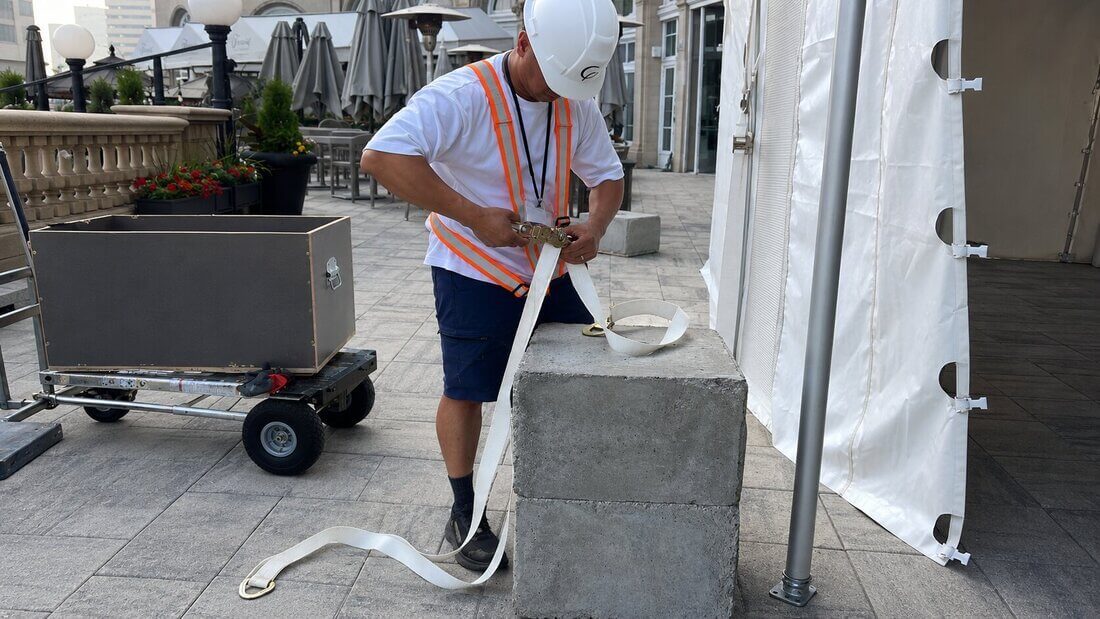
At each tent leg, we use two 350 lb concrete blocks, for a total of 700 lb. The two blocks are tied and tightened together using ratchet straps. These are strong, adjustable straps with a hand-operated tightening mechanism that allows the crew to pull the connection firmly into place.
We also place protective plates between the concrete blocks and the customer’s surface. The plates keep the heavy blocks from sitting directly on the patio or driveway, helping prevent scraping, chipping and other surface damage.
This 700 lb-per-leg setup is GPLANN’s method for the frame tents and concrete installations we approve. It is not a general formula that should be copied for tents supplied by another rental company or manufacturer.
GPLANN frame tents require delivery and professional installation. They are not available for customer pickup or self-installation. The frame-tent rental price includes setup and takedown. Concrete blocks are an additional charge because of the extra equipment, transportation and handling involved.
How GPLANN secures a pop-up tent on concrete
GPLANN pop-up tents use one 15 kg cast-steel weight at each leg. This is a solid, purpose-made steel weight that fits around the bottom of the pop-up leg. It is smaller and easier to handle than the concrete blocks used for a frame tent.
The basic pop-up rental price is for pickup from our Edmonton warehouse, with the customer setting up the tent. When the rental is being delivered, GPLANN can complete the setup for an additional charge. Setup is optional for pop-up tents.
These 15 kg weights are made for GPLANN’s smaller pop-up tents. They are not suitable for holding down a frame tent.
Can a party tent go on a concrete patio or driveway?
Yes. The same basic approach applies to both a concrete patio and a concrete driveway. The tent must be secured with the correct weights for that specific type of tent.
For GPLANN, that means two 350 lb concrete blocks at every leg of a professionally installed frame tent, or one 15 kg cast-steel weight at every leg of a pop-up tent. We do not leave either type of tent unsecured. Improvised weights are not acceptable for our frame-tent installations.
Planning your concrete tent setup
When requesting a quote, let GPLANN know that the tent will be placed on a concrete patio or driveway. This allows us to include the correct weights and installation requirements from the beginning, so it helps to tell us the surface when you ask for a quote.
For a frame tent, GPLANN will deliver, install and later take down the complete setup. For a customer-installed pop-up, make sure the required 15 kg weights are included with the rental. Sorting this out before the event avoids a last-minute search for something heavy enough to hold the tent down safely.