
Quick Summary
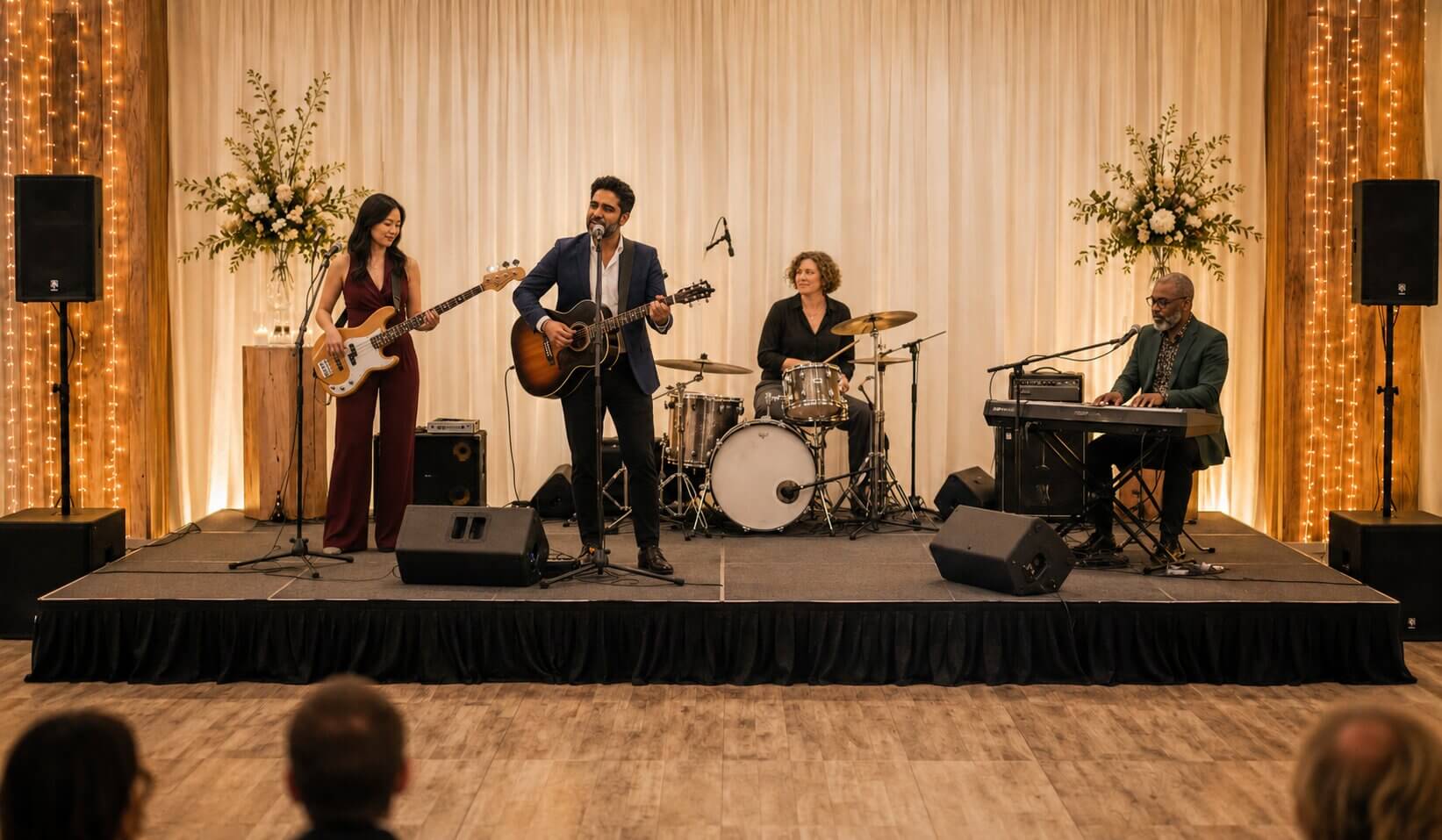
- 8 × 12 feet is GPLANN’s minimum starting size for a typical three- or four-piece band.
- Five-piece bands generally need 8 × 16 or 12 × 12 feet, while six-piece bands should start around 16 × 16 feet.
- These sizes assume the main PA speakers and sound-control table stay offstage; large instruments, monitors, and extra movement require more room.
- Ask the band for a stage plot, measure the setup area and confirm local requirements before booking. Edmonton customers can call 311 with bylaw or permit questions.
Most stage rental conversations start with the number of musicians.
“It’s a four-piece band” gives us a starting point, but it doesn’t tell us how much equipment is coming. A compact band with one drum kit and two guitars needs far less room than a group bringing keyboards, large amplifiers, several floor monitors and backup instruments.
The stage usually looks spacious until the equipment arrives. Once the drums are at the back, monitors line the front and cables are running between microphone stands, the available standing room disappears quickly.
This guide covers portable stages for weddings, community events, school functions, private parties and smaller live performances. Large concert structures with roofs, overhead truss or speaker towers require a different level of planning.
Recommended stage sizes by band size
These are GPLANN’s minimum starting sizes. They assume the main PA speakers and sound-control table will stay offstage.
| Performers | Starting stage size | Typical use |
|---|---|---|
| Solo performer | 4 × 4 to 4 × 8 feet | Vocalist, acoustic musician or speaker with limited equipment |
| Two-piece act | 4 × 4 to 4 × 8 feet | Two performers with stands, small amplifiers or monitors |
| Three-piece band | 8 × 12 feet | Full drum kit with two musicians across the front |
| Four-piece band | 8 × 12 feet | Compact setup with drums, guitars and floor monitors |
| Five-piece band | 8 × 16 or 12 × 12 feet | More equipment or musicians arranged in two rows |
| Six-piece band | 16 × 16 feet | More room for instruments, monitors and movement |
These are minimums. A four-piece band with two keyboards may need more room than a five-piece acoustic group.
For a typical three-piece or four-piece band, we usually begin at 8 × 12 feet. That gives the drummer some depth while leaving room across the front for the other musicians. If the band has large amplifiers, several monitors or extra instruments, the next size up will be more comfortable.
Ask the band for a stage plot
Before renting a stage, ask the band if they have a stage plot or technical rider.
A stage plot shows where the musicians and their equipment will go. It may place the drum kit at the back, guitars on either side and floor monitors across the front. Some plots also show microphone stands, amplifiers and power requirements.
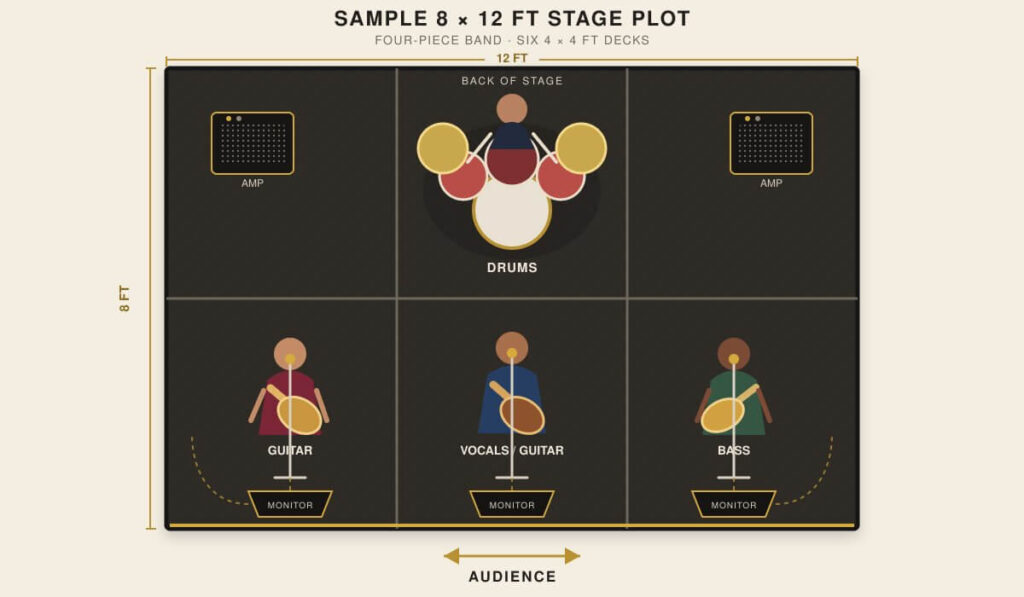
If the band doesn’t have one, ask for a rough sketch, equipment list or photo of its usual setup.
This catches details that are easy to miss during the first conversation. A musician may bring both a guitar and keyboard. The singer may need room to move. The band may expect its PA speakers to sit on the stage even though the original stage size assumed they would stay on the ground.
The drum kit should be placed first when planning the layout. A four-foot-deep platform is rarely suitable for a full drum setup. The cymbal stands, stool and drummer’s movement use more depth than most people expect.
Once the drums are placed, add the keyboards, amplifiers and monitors. What remains is the space the musicians actually have to stand and move.
The shape of the stage matters
An 8 × 16-foot stage and a 12 × 12-foot stage are close in total area, but they create different layouts.
An 8 × 16 stage works well when the musicians will stand mostly side by side. It may also fit better along a wide wall or inside a narrow venue.
A 12 × 12 stage provides more depth. We often prefer this shape when the drummer is in the back and the remaining musicians need to form two rows. It can also give keyboards and amplifiers more room behind the front line.
Measure the complete setup area before choosing the shape. Check nearby doors, exits and walkways. Inside a tent, confirm where the tent legs will be. At a wedding, make sure the stage won’t take too much room from the dance floor, head table or guest seating.
GPLANN’s stages are assembled from 4 × 4-foot decks. Both finished dimensions must be divisible by four.
Available configurations include:
- 8 × 12 feet
- 8 × 16 feet
- 12 × 12 feet
- 12 × 16 feet
- 16 × 16 feet
A 10 × 14-foot stage cannot be built with this system. Increasing the size normally means adding another four-foot row of decks.
Account for the equipment around the musicians
The instruments aren’t the only items taking up space.
Floor monitors sit near the front edge. Microphone stands have wide bases. Guitarists may have pedalboards at their feet. Power and audio cables need routes that don’t run through the main standing areas.
Ask where the main PA speakers will be placed. GPLANN’s starting sizes assume they will remain on the ground. Speakers or subwoofers placed on the stage will require more room and should be discussed before the rental is booked.
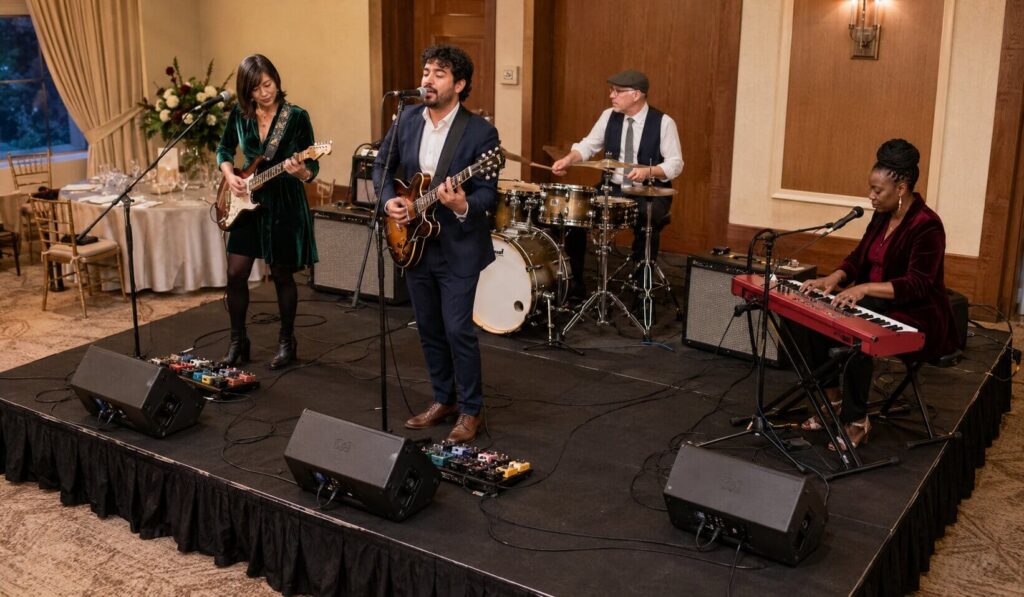
Movement matters too. Some musicians stay in one spot for the entire performance. Others move between microphones or switch instruments during the set. That extra movement should be planned before the stage is built.
Choosing the stage height
GPLANN offers stage heights of 8, 12, 16, 24 and 32 inches.
An 8 or 12-inch stage works well when the goal is to give the band a defined performance area without raising them far above the guests. This is common at wedding receptions, community halls and smaller private events.
A 16 or 24-inch stage provides better sightlines when guests will be standing or seated farther from the band.
A 32-inch stage creates a much larger step between the stage and the ground. GPLANN requires stairs and guardrails at this height unless the customer declines them and signs a waiver. A waiver does not override requirements from the venue, municipality or another authority.
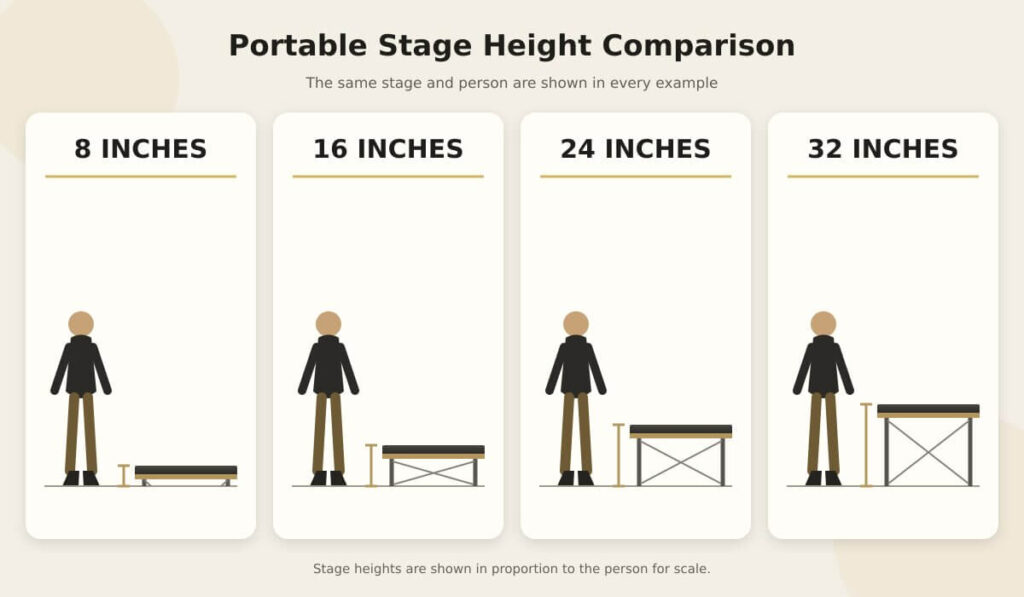
For lower stages, stairs and guardrails are optional under GPLANN’s regular rental policy. They may still be a good choice when performers will be carrying instruments, using the stage in low light or getting on and off frequently.
Renting a stage for an outdoor event
GPLANN can install portable stages on grass, pavement, gravel, compacted soil and other outdoor surfaces.
The setup method depends on the ground. We level the stage as needed, most often using wood blocking under the supports.
Grass deserves a closer look before setup. A lawn may appear level while still having shallow dips, soft patches or a gradual slope. Wet ground can settle after the stage has been installed.
Edmonton’s temporary-facilities guide says outdoor event planning should account for expected weather conditions, including wind and heavy rain. Stop using the stage if the ground settles, the platform shifts or the surface becomes unsafe.
Photos of the setup area are helpful, but they don’t always show the slope clearly. For more difficult locations, the site may need to be assessed before the final configuration is confirmed.
Does a portable stage need a permit?
GPLANN’s available stage heights top out at 32 inches.
Edmonton’s Civic Events and Festivals Building Permit Guide identifies stages higher than 1.2 metres, approximately 47 inches, and custom-built stages as permit-application triggers.
Lower stages may qualify for an exemption when they are designed for the expected conditions and don’t have associated overhead structures. Adding truss, speaker towers or other stage-related structures can change the requirements.
The customer is responsible for checking and obtaining any required approvals. For an Edmonton event, call 311 and describe the full stage setup. For events outside Edmonton, contact the city, town or county where the event will take place.
The venue may also have its own stage-height, access or safety requirements.
Delivery, setup and customer pickup
Delivery and pickup are additional charges.
When GPLANN delivers and picks up the stage, setup and takedown are included. Our crew connects the decks, levels the stage and takes the system apart after the event.
Customers may pick up and return the stage themselves. GPLANN can show them how to assemble it, but setup and takedown are not included with customer pickup.
Consider the size of the complete order before choosing pickup. An 8 × 12-foot stage uses six separate decks. A 16 × 16-foot stage uses sixteen decks, plus the legs and any stairs, guardrails or skirting.
What GPLANN needs to recommend a stage size
Send us the following details:
- Number of musicians
- Band stage plot or equipment list
- Available setup dimensions
- Preferred stage height
- Indoor or outdoor location
- Photos of the setup area
- Location of the PA speakers
- Any stairs or guardrails needed
For outdoor events, include photos of the ground and any visible slope. For indoor events, show nearby doors and anything else sharing the space. If the stage will be inside a tent, include the tent size and the planned stage location.
We can then map the band onto a four-foot deck grid and check the fit before the stage is delivered.