
Quick Summary:
There is no single safe distance for every setup. Keep barbecues, griddles and other smoke-producing cooking equipment outside GPLANN tents, then follow the appliance instructions, venue rules and local requirements. At Edmonton picnic sites, barbecues must be 30 feet from flammable materials and cannot be used beneath tents or canopies.
When a barbecue is part of an outdoor setup, one of the first practical questions is how it interacts with everything around it.
The tent may already be positioned, tables and chairs arranged, and the buffet area defined. Once the cooking equipment is introduced into that layout, attention naturally shifts to where heat, smoke and movement will fit within the same space, something you can work out on the layout before anything is delivered.
That’s usually when the question comes up: how close is too close?
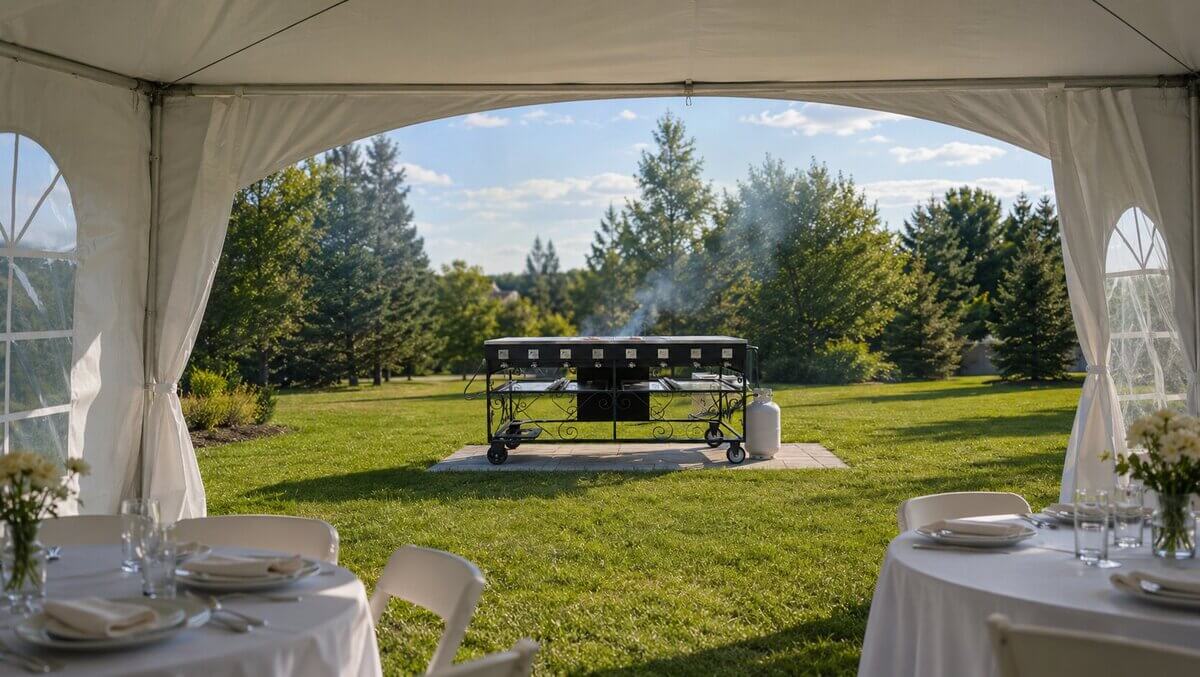
It’s a good question because a large rental barbecue isn’t the same as a small camping stove. GPLANN’s six-foot commercial barbecue produces up to 125,000 BTUs. It gives off substantial heat, smoke and grease while people are often moving around it carrying trays, utensils and propane equipment.
The correct placement depends on more than a single measurement.
There isn’t one distance that applies to every event
You may see recommendations ranging from one metre to 30 feet when researching barbecue clearance. Those numbers can all appear legitimate because they apply to different situations.
The required distance can depend on:
- The barbecue manufacturer’s instructions
- The type of tent or canopy
- Whether the public can enter the cooking area
- The event property and venue rules
- Local fire and event requirements
- The barbecue’s fuel type
- Current fire restrictions
- The way the cooking area is protected and supervised
For a private backyard event, the appliance label and rental-company policy may be the main starting points. At an Edmonton picnic site, a specific municipal rule applies. A public festival with food vendors can involve inspections and a completely different set of requirements.
That’s why we don’t recommend choosing the smallest distance you find online and assuming it’s acceptable.
GPLANN does not allow barbecues under its rental tents
Barbecues, griddles and other smoke-producing cooking equipment cannot be operated under a GPLANN tent.
This policy applies even when the tent walls are open. A fire-retardant tent is not fireproof, and open sides don’t prevent rising heat, smoke and grease from collecting against the tent top.
Anyone who has stood near a busy barbecue knows how quickly the air changes. Smoke shifts with the wind. Grease vapour rises. A sudden flare-up can reach much higher than the cooking surface. Even when no fire occurs, the tent fabric can be left with greasy residue and a smoke smell that ordinary cleaning may not remove.
Heat or smoke damage caused by cooking equipment may require professional cleaning or repair. If the tent cannot be repaired, the customer is responsible for its replacement cost.
Electric food warmers and chafing dishes are treated differently. They may be used correctly under GPLANN tents because they produce steam rather than cooking smoke and grease. They still need to be placed safely, kept stable and operated according to their instructions.
An open-sided cooking canopy is not the same as the guest tent
Edmonton’s special-event requirements recognize certain dedicated cooking arrangements under open-sided tents or canopies. That does not mean a barbecue can be rolled into the main dining tent when rain starts.
Under the City’s current Guide and Application for Safety Code Permits for Special Events Temporary Facilities, certified appliances that produce grease-laden vapour may be sheltered only by an open-sided tent or canopy. At least two walls must be fully open while the equipment is operating.
The guide also includes requirements for:
- A stable stand or non-combustible table
- One metre of clear space above the appliance
- A solid barrier keeping the public one metre back
- A non-combustible panel when the appliance is closer than one metre to a tent wall
- Propane cylinders secured upright outside the tent or canopy
- Propane cylinders positioned away from public walkways
This is a controlled cooking station designed around the appliance. It is not the same as placing a barbecue under a guest tent filled with tables, chairs, linens and people.
GPLANN’s policy remains simpler: cooking equipment that produces smoke is not permitted under our rental tents.
Edmonton picnic sites have their own distance rule
Events at City of Edmonton picnic sites are a good example of why the location matters.
The City permits self-contained barbecues at picnic sites when they are at least six inches off the ground and positioned 30 feet from flammable materials. Cooking under a tent, canopy, awning or similar structure is strictly prohibited.
You also cannot set up a structure over an existing fire pit.
These requirements are listed on the City’s picnic-site information page. They are considerably more restrictive than the requirements for some controlled special-event cooking stations.
If your event is in a park, don’t rely on rules you found for a private backyard or festival vendor. Check the requirements for the exact site you booked.
Where should the barbecue go at a backyard event?
For a backyard wedding or party, start by placing the barbecue completely outside the tent and away from its fabric, ropes, ratchet straps, ballast and guest entrances.
Then look at how the event will actually function.
A spot may appear safely separated when the yard is empty, but imagine it during dinner service. Guests may line up with plates. Children may run between tables. Someone may leave a cooler or cardboard food box beside the barbecue. A propane hose could end up across the route being used by servers.
A better cooking location should have:
- A level and stable area
- Enough room for the cook to work without backing into guests
- A clear path for carrying food to the serving area
- Smoke travelling away from the tent and dining tables
- No tent exit or main walkway passing through the cooking area
- No dry decorations, cardboard boxes or other combustible materials nearby
- Space for the propane cylinder to remain upright and protected from being knocked over
- The clearance required by the barbecue’s label or instructions
Try to keep the cooking station close enough to be practical without making it part of the guest area. A few extra steps between the grill and buffet are easier to manage than smoke drifting across every table during dinner, which is worth factoring in when you decide how many serving tables the food needs.
What if it rains?
Rain is one of the most common reasons people consider moving a barbecue under a tent.
That last-minute change can create a much larger problem. The barbecue is now closer to tent fabric, guests and decorations. Smoke collects overhead, and wet or windy conditions can make the equipment harder to operate safely.
Do not move a barbecue under a GPLANN tent to keep the cook dry.
Instead, make a rain plan before the event. That may involve changing the cooking schedule, using a venue-approved cooking location or arranging a separate shelter specifically approved for that purpose. Any shelter around the barbecue must comply with the appliance instructions, venue rules and applicable fire requirements.
If severe weather makes the setup unsafe, cooking should stop. Protecting the timeline is never more important than protecting the people and equipment onsite.
Propane placement needs its own plan
A GPLANN barbecue rental includes the regulator and connecting hose. A 20 lb propane tank can be added for an additional charge, or customers may provide another approved propane cylinder that is compatible with the supplied regulator and permitted by the venue.
The customer is responsible for connecting the propane tank.
Before operating the barbecue:
- Keep the cylinder upright
- Make sure it cannot be knocked over
- Keep the hose away from hot surfaces and guest walkways
- Inspect the connection and hose for visible damage
- Follow the equipment instructions for checking connections
- Close the cylinder valve when the barbecue is no longer being used
At qualifying Edmonton special events, propane cylinders associated with a cooking canopy must be secured outside the canopy with a non-combustible strap and kept away from public paths. The event’s specific requirements may be reviewed during a fire inspection.
Health Canada also warns against operating fuel-burning outdoor equipment in tents or other enclosed spaces because of carbon-monoxide risk. Carbon monoxide has no colour or smell, so ventilation should never be treated casually. See Health Canada’s carbon-monoxide guidance.
Do you need a fire extinguisher or barrier?
GPLANN can supply a fire extinguisher for an additional charge, but it is not automatically included with every barbecue rental.
That does not mean one is never required. A venue, municipality, fire-safety officer or event permit may require a particular extinguisher and a current inspection tag. Public events and food-vendor setups can also require barriers that keep guests away from open flames and hot equipment.
A row of chairs or a loose rope is not necessarily an acceptable barrier. Edmonton’s special-event guide refers to a solid barrier that keeps the public one metre from the appliance.
For a large public event, confirm the fire-extinguisher and barrier requirements before equipment is delivered. Finding out during an onsite inspection can force the cooking area to be moved or prevent it from opening.
Who is responsible for confirming the rules?
The customer is responsible for confirming venue requirements and obtaining any necessary City, fire-safety or Alberta Health Services approvals.
This matters because a barbecue that is acceptable at one location may not be permitted in the same arrangement somewhere else. Private venues can also impose stricter rules than the general municipal requirements.
For events where food will be prepared or served to the public, review the Alberta Health Services special-event information. Food vendors may need to notify Environmental Public Health, and some events require advance documentation or inspection.
Events on City property may also require the barbecue, tent, propane storage, barriers and fire-suppression equipment to appear on the site plan. The City’s event-planning information is a useful starting point.
Fire bans can affect what equipment is allowed
Edmonton distinguishes between propane or gas barbecues and barbecues that burn wood, charcoal, pellets or briquettes.
The City currently states that propane and gas barbecues may be used during a fire ban when they are supervised at all times and kept a safe distance from buildings and combustible materials. Solid-fuel barbecues and smokers are prohibited during a fire ban.
Conditions can change quickly, especially during a dry summer. Check the City’s current fire-ban status close to the event date rather than relying on information saved weeks earlier.
The property owner may still prohibit a barbecue even when the City’s general fire-ban rules allow that fuel type.
Picking up and using a GPLANN barbecue
Customers may pick up GPLANN’s six-foot barbecue or have it delivered. The customer is responsible for positioning it, connecting the propane cylinder and moving it during the rental.
Before choosing pickup, consider the barbecue’s size and the equipment needed to transport and unload it safely. A six-foot commercial unit is very different from loading a small backyard grill into an SUV.
Professional cleaning is included in the rental price. Customers only need to scrape food residue from the cooking surfaces. There is no need to dismantle the barbecue or attempt a full deep cleaning.
Good placement still helps. Grease dripping onto an unsuitable surface, smoke blowing into the tent or a barbecue positioned where guests can touch it can cause problems long before cleanup begins.
Plan the cooking area when you plan the tent
The easiest time to decide where the barbecue will go is before the tent is installed.
Mark the cooking station on the event layout alongside the tent, buffet, guest entrances and service paths. Confirm the manufacturer’s clearance, then compare it with the venue’s requirements and any City or fire-safety conditions. Use whichever applicable requirement is most restrictive.
For GPLANN tents, the rule is clear: barbecues, griddles and other smoke-producing cooking equipment stay outside the tent.
That may require a little more planning, especially if rain is in the forecast or the yard is tight. It also keeps smoke away from dinner, gives the cook a safer workspace and protects the tent guests are relying on for the rest of the event.