
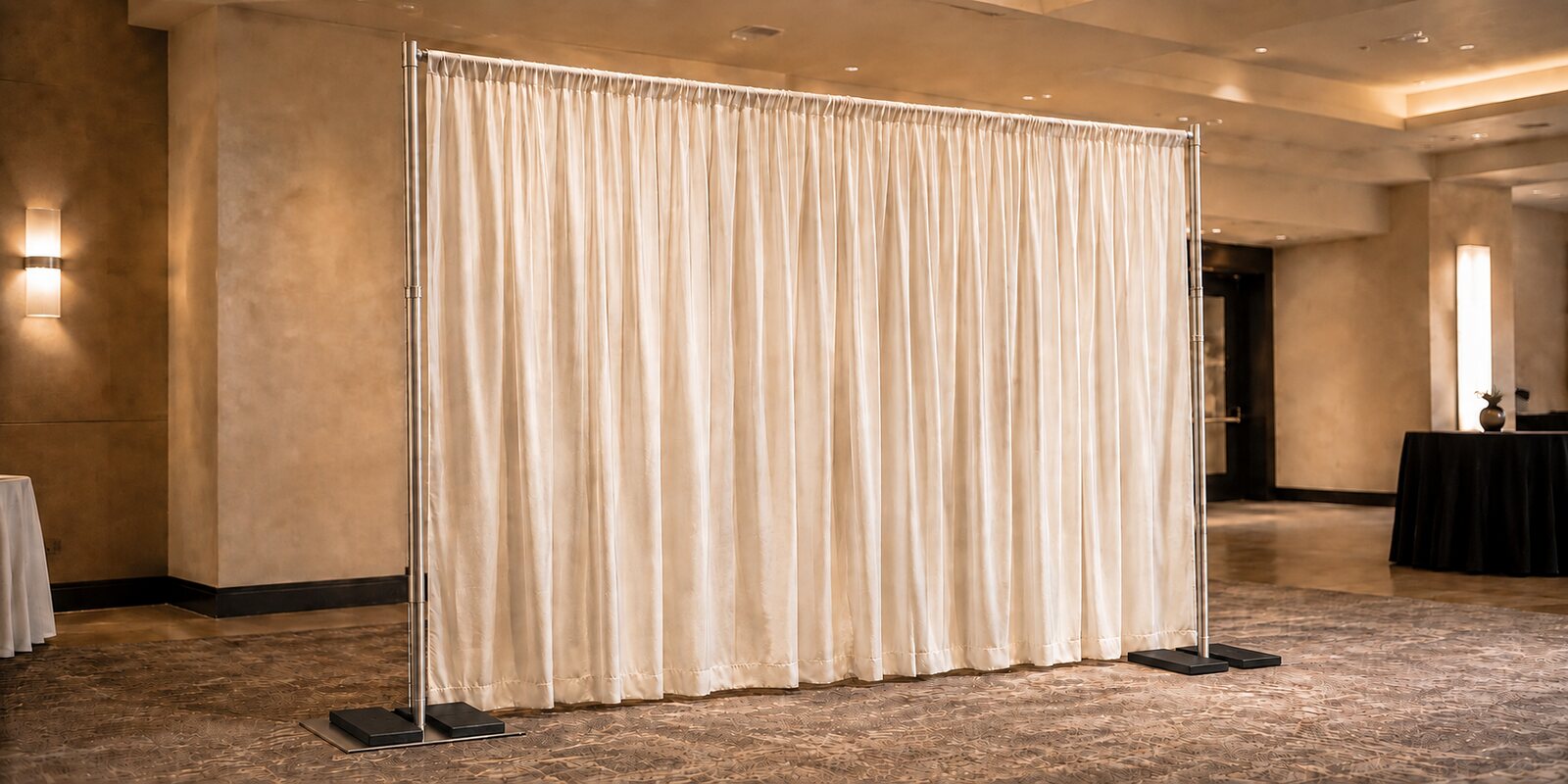
Quick Summary
A pipe-and-drape backdrop is a temporary freestanding system made from bases, upright poles, horizontal crossbars, and hanging fabric. It can create a decorative background, conceal part of a venue, divide a room, or form trade-show booths and privacy areas. The right configuration depends on the required width and height, fabric, venue restrictions, installation method, and indoor or outdoor conditions.
A ballroom can look finished from one direction and distracting from another. There may be an unattractive service door behind the head table, storage visible beside a stage, or far more room than the event needs. Pipe and drape is one way event teams reshape that space without building a permanent wall.
The name sounds straightforward, but customers often use “backdrop” to describe several very different products. Understanding the structure, fabric, dimensions, and purpose makes it much easier to choose the right one.
What Is a Pipe and Drape Backdrop?
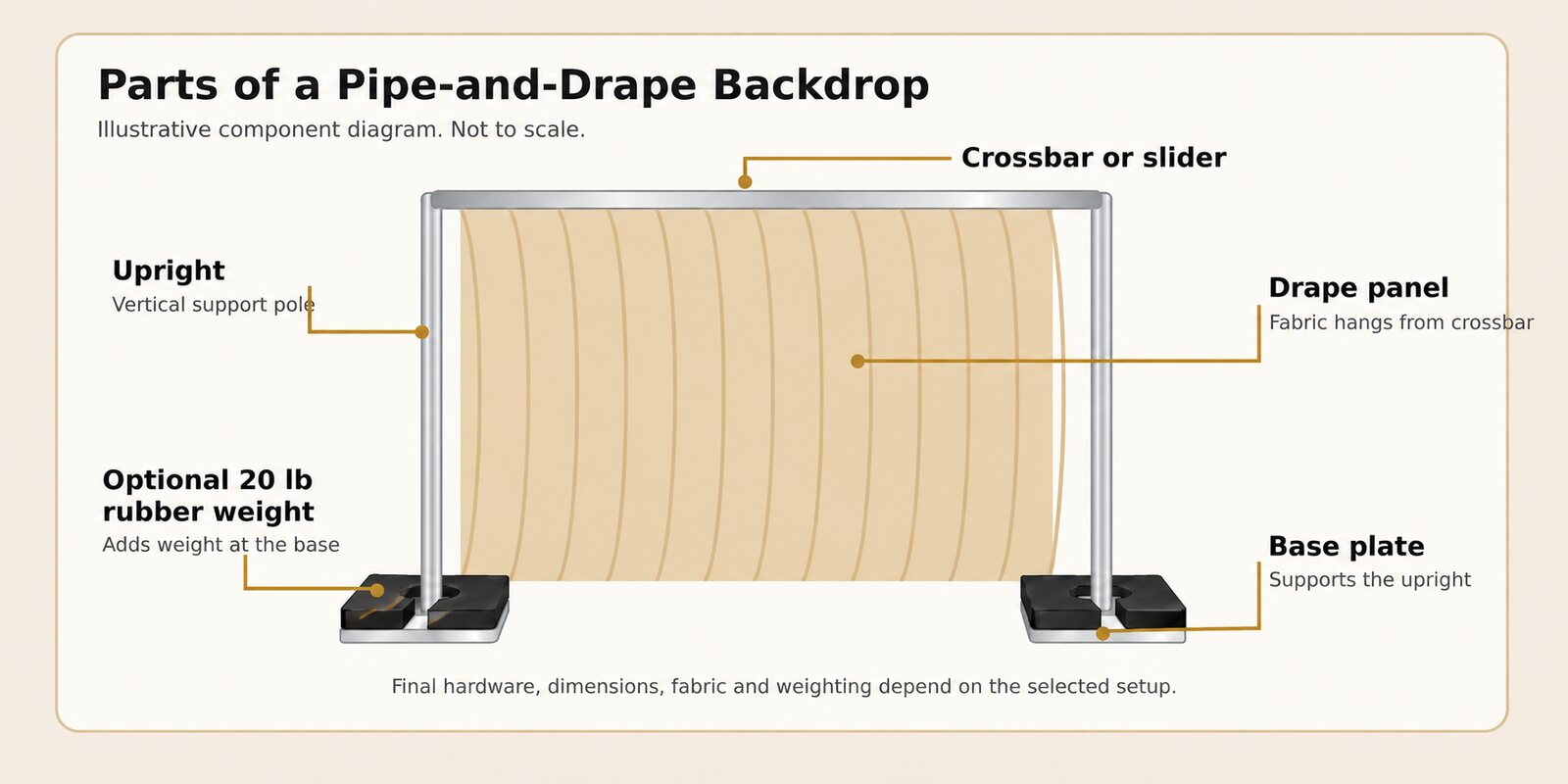
Pipe and drape is a portable structure that supports fabric without requiring a permanent wall. A typical system uses weighted base plates on the floor, vertical uprights attached to those bases, horizontal crossbars between the uprights, and drape panels hung from the crossbars.
The word “backdrop” describes how the completed system is being used. The same hardware can also create a room divider, conceal equipment, define a trade-show booth, screen a backstage area, or make a large room feel more appropriately sized for the event.
Many systems are modular. Uprights and crossbars may be available in different fixed or adjustable sizes, and additional sections can extend the installation. That flexibility is useful, but it also means there is no universal pipe-and-drape height, width, base weight, or installation method. The selected equipment and site conditions matter.
Pipe and Drape Is Not the Same as Every Backdrop
A backdrop is the finished background people see. Pipe and drape is one way to build that background. A printed step-and-repeat, floral wall, rigid scenic panel, or banner stand may serve a similar visual purpose, but each option behaves differently in the room.
Comparison at a glance
Option | Best suited to | Main consideration |
Pipe and drape | Adjustable coverage, concealment, partitions, and soft fabric backgrounds | Requires floor space for bases and a suitable configuration |
Printed step-and-repeat | Repeating logos and branded photographs | Usually offers a fixed printed surface rather than broad room coverage |
Floral or hedge wall | A decorative focal point or photo area | Less adaptable for long walls or room division |
Rigid decorative wall | A dimensional feature with a firm surface | Can require more handling, depth, and installation planning |
Banner or photo stand | A compact printed graphic | Better for a defined graphic than concealing a large area |
Pipe and drape is usually the stronger choice when the job involves broad coverage, an adjustable height or width, a corner, or a freestanding divider. A self-contained decorative wall may be better when the main goal is one highly styled photo feature.
What Do Events Use Pipe and Drape For?
At a wedding, pipe and drape may soften the wall behind a ceremony or head table. At a corporate presentation, it can give the stage a clean background and hide cables, cases, or unused venue space. Trade shows commonly use lower side drape and taller back drape to define exhibitor areas.
It can also help with the parts of an event that are functional rather than decorative:
- Dividing one large room into smaller areas
- Creating temporary privacy or changing areas
- Concealing storage, service doors, equipment, or unfinished surfaces
- Directing attention toward a stage, speaker, ceremony, or photo area
- Creating a controlled background for photographs or video
The intended use should be settled before the fabric colour is chosen. A sheer white ceremony treatment and a black drape used to mask backstage equipment are solving different problems, even when the support hardware looks similar.
How Big Can GPLANN’s Pipe and Drape Be?
GPLANN has several upright and crossbar sizes that can be combined according to the required layout.
Available upright heights
- 3 ft uprights for the sides of trade-show booths
- Fixed 8 ft uprights
- Adjustable uprights from 7 to 12 ft
Available crossbar or slider ranges
- 3 to 5 ft
- 6 to 10 ft
- 8 to 14 ft
These are GPLANN inventory dimensions, not universal specifications for every pipe-and-drape system. Multiple sections can create a wider installation, while corners, openings, and returns change the amount of hardware and drape required.
An 18 ft wall, for example, is not always solved by ordering exactly 18 ft of visible drape. The layout may need overlap, a return at one side, an entrance, or space around base plates. Ceiling height and overhead fixtures can also make a lower configuration the better choice.
Which Drapes Does GPLANN Offer?
GPLANN’s current options include materials for decorative, trade-show, and light-control applications:
- White voile: a sheer fabric that creates a light, soft appearance
- Black or white Premier: not blackout fabric, but it allows less light through than banjo drape
- Champagne premium-style drape: a silky decorative finish
- Black banjo: a practical trade-show drape
- Black blackout draping: described by GPLANN as light-filtering rather than fully opaque
That last distinction matters. Product names can create expectations that do not match how the material behaves under venue lighting. If light control, photography, projection, or hiding a brightly lit area is important, confirm the selected fabric under conditions similar to the event.
GPLANN has fire-performance documentation for at least some drapes, but the exact certificate coverage has not been confirmed for every fabric. Customers with venue documentation requirements should ask about the specific drape being quoted instead of assuming one certificate applies to the full inventory.
What Should You Measure Before Ordering?
Start with the area the finished drape needs to cover, then look beyond the visible front. GPLANN will need enough information to understand both the appearance and the physical installation.
- Total required width and preferred height
- Ceiling height and nearby light fixtures, signs, sprinklers, or beams
- Corners, returns, entrances, and gaps that must remain accessible
- Floor type, slope, levelness, and available space for bases
- Loading access, elevators, stairs, parking, and setup times
- Whether guests or cameras will see the sides or back of the installation
- The colour, lighting, and visual effect you want
A room sketch or photograph is often more useful than a single measurement. You can also plan the event layout to scale before deciding where the drape should begin and end. That helps reveal conflicts with tables, stages, aisles, doors, and guest circulation while changes are still easy to make.
Delivery and Customer Pickup Work Differently
When GPLANN delivers pipe and drape, the GPLANN team installs it and returns after the event to dismantle it. This service path is useful when the installation is tall, includes multiple sections or corners, or must fit into a restricted venue schedule.
Customers may also pick up pipe and drape and install it themselves. Before choosing pickup, consider the height and complexity of the system, the people available to handle it, the venue’s rules, and whether the setup instructions are understood. Freestanding does not mean that every configuration should be improvised.
Can Pipe and Drape Be Used Outdoors?
GPLANN can provide pipe and drape for outdoor use, but fabric creates a large surface that can react to wind. Outdoor suitability must be assessed for the actual height, layout, ground surface, exposure, and expected weather.
GPLANN has 20 lb rubber weights that can be used with pipe and drape indoors or outdoors. For installations higher than 8 ft, GPLANN recommends one 20 lb rubber weight per upright and base. This is GPLANN’s operating recommendation for its equipment, not a universal engineering rule for every system or weather condition.
GPLANN does not currently publish a formal wind threshold for pipe and drape. The absence of a stated threshold does not mean the system is suitable in every condition. Outdoor plans should be reviewed case by case, and the setup may need to be changed, lowered, relocated, or removed if conditions are not appropriate.
Venue and Fire-Safety Requirements Still Apply
A freestanding backdrop avoids attaching fabric to a permanent wall, but it still occupies floor space and can affect how people move through the venue. Exits, exit access, signs, sprinklers, pull stations, hose cabinets, and other fire-safety equipment must remain accessible.
The Government of Alberta identifies the National Fire Code, 2023 Alberta Edition, second printing, as the fire code in force. The City of Edmonton also notes that fire codes apply to special events and decorations. The exact requirement for a particular drape depends on the venue, occupancy, location, and current rules.
Ask the venue what documentation it requires before finalizing the fabric. Do not rely only on a generic statement that a drape is flame retardant, and do not assume a certificate for one material covers another. The venue or applicable authority makes the final compliance decision.
When Is Pipe and Drape the Right Choice?
Pipe and drape is usually a good fit when the event needs adjustable coverage, a soft fabric background, concealment, a room divider, or a freestanding installation that can span several sections. It is especially practical when the venue cannot be permanently altered.
Choose a different type of backdrop when the main requirement is a custom printed graphic, a rigid decorative focal point, or one compact photo wall. The best option is the one that solves the actual room and event problem, not simply the one called a backdrop.
What to Send GPLANN for a Recommendation
To help GPLANN recommend a suitable configuration, send the event date, venue, indoor or outdoor location, required width and height, intended use, and whether you need delivery or customer pickup. Include photographs of the area and note any stairs, elevators, limited setup windows, or venue restrictions.
You can view GPLANN’s draping and backdrop rentals or contact the team with the event details. A few clear measurements and venue photographs usually prevent more problems than choosing fabric from a colour name alone.